
How Long Does External Rendering Last? (And What Affects It)
It's one of the first questions people ask us on a quote. The honest answer is: it depends on the system you choose, how well it's applied, and what kind of punishment the weather dishes out. On the north Cornish coast, that last part is serious.
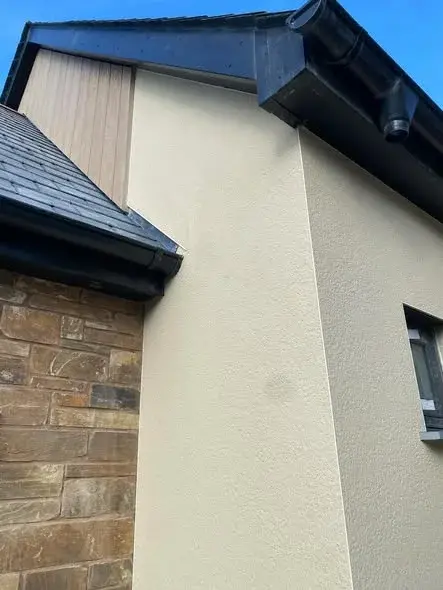
Not all render is the same
When people ask “how long does render last?” they usually mean a single thing, but there are actually several quite different systems — silicone render, monocouche, cement-sand, lime, and modern EWI finishes. Each behaves differently over time. Lumping them together gives you a meaningless average, which is why we want to run through them one by one.
The other thing worth saying upfront: the same system applied badly will fail in five years. Applied properly onto a prepared substrate with the right primer and the right conditions, it should hit its designed lifespan. Application quality genuinely matters more than brand loyalty.
How long does silicone render last?
A properly applied silicone render system should last 25 to 30 yearswithout needing replacement. The silicone polymers in the topcoat stay flexible and water-repellent over that period — the surface doesn't get brittle and doesn't absorb water the way older cement systems do. The through-colouring means you won't be repainting it every few years either.
That 25–30 year figure assumes the render was applied onto a sound substrate with a suitable primer, and that the property gets a soft wash every five to seven years to keep algae from building up. On a well-maintained coastal house in Bude or Widemouth Bay, silicone is the system we'd put our name to for the long term.
How long does monocouche last?
Monocouche — the cement-based one-coat system — typically gives you 20 to 25 years on a well-sheltered property with a solid substrate. On new blockwork extensions, it performs very well. The material is denser and harder than silicone, which works in its favour on clean, stable buildings.
The lifespan shortens if the property is exposed. Monocouche is more rigid than silicone, so it's more susceptible to freeze-thaw cracking in cold wet winters. In Cornwall that matters — We don't get prolonged frosts but we do get repeated overnight freezes in January and February. Over 20 years those add up, especially on a property facing west toward the Atlantic.
How long does lime render last?
Lime render is in a different category entirely. On an old Cornish stone or cob cottage, a lime render that was applied in the 1920s might still be doing its job today. Properly maintained, lime render is essentially indefinite — but it does need maintenance. It moves with the building, it breathes, and small repairs are straightforward if you catch them early.
The key phrase is “properly maintained.” Lime is a sacrificial material in the best sense: it absorbs movement and lets moisture through rather than locking it in. But that means it can erode or develop small cracks over time, and you need to patch them before water gets in behind. If you ignore it for a decade, the repair bill climbs sharply.
What shortens render life
Salt sprayis the big one in Cornwall. Properties within half a mile of the sea get a constant coating of salt-laden air. Salt draws moisture into porous surfaces and accelerates the freeze-thaw cracking we mentioned. It's why silicone — with its hydrophobic surface — genuinely outperforms cement-based systems on the coast.
Pressure washing is probably the most common thing homeowners do that damages their render. People see algae or lichen building up and reach for a pressure washer. At high pressure it strips the surface texture, forces water behind the render, and in extreme cases blows sections clean off. Never pressure wash render. A soft wash with appropriate biocide is what you want.
Poor applicationcovers a lot of sins — applying over a dusty or loose substrate, skipping the primer, applying in frost or direct summer sun, incorrect mixing ratios. These don't show up immediately, but they shorten the lifespan dramatically. A render job that looks fine at handover can start lifting at the edges within a couple of years if the substrate prep was wrong.
How to get more years out of render
Soft wash every five to seven years is the single most useful thing you can do. A low-pressure wash with a diluted biocide solution kills algae and moss before they get a proper foothold, and it removes the surface grime that makes the wall look tired long before the render itself has failed. Most silicone renders will look close to new after a proper soft wash.
Keep your gutters clear and your downpipes running cleanly. Water running down the face of a rendered wall from a blocked gutter does more damage in a wet Cornish winter than almost anything else. It concentrates moisture in one place, promotes algae growth and can cause the render to delaminate if there's a crack or a weak point. It's a cheap fix that saves a lot of money.
Check around window and door reveals every couple of years. The joints between the render and the frames are the most vulnerable points — they take thermal movement every day. If the sealant opens up, water gets in. A tube of the right sealant costs next to nothing; ignoring it and letting water get behind the render does not.
Our honest verdict
Good render on a well-prepared wall will last 20–30 years without drama. The system choice matters — silicone for anything coastal or exposed, monocouche for sheltered new-builds — but the application quality and the basic maintenance are what separate a 15-year job from a 30-year job.
Cornwall's climate is genuinely tough on external render. The combination of Atlantic rain, salt air, and freeze-thaw cycles means you can't just fit and forget. But if you choose the right system and keep on top of the soft washing, you should get excellent value from a quality render job for a very long time.
Got a job in mind?
Call us on 07761 735022 or message on WhatsApp.
Related articles
Written by the PureRend team — plastering and rendering specialist in Bude, Cornwall.